The Trading Session
Chapter 6 — The Trading Session
1. Definition
A trading session is a fixed window of the clock during which a particular set of participants is active, and during which price behaves with a recognisable character. [TM-01]
Sessions are not arbitrary divisions of the day. They are the hours when specific desks in specific cities are staffed and transacting. When those desks change over, the character of delivery changes with them — and that change is what you are learning to read.
Every session boundary in this book is stated in New York time. Not your local time, not exchange time, not UTC. New York time, every chapter, all eight volumes. Set your charts to it now and never think about it again. More models have been broken by a timezone assumption than by a bad entry rule.
2. Institutional reasoning
Orders are placed by people and systems that work business hours. A London desk with a large position to fill will work it during London hours, because that is when its risk managers are awake, its liquidity providers are quoting, and its counterparties are reachable.
This has two consequences you can trade against.
Volume concentrates. A desk that needs to fill size waits for the hours when enough of the other side is present. Filling a large order into thin Asian liquidity moves the price against yourself; waiting for London or New York does not. So flow clusters, and the clusters sit at predictable clock times.
Session extremes become reference points. When a session closes, the high and low it printed do not stop mattering. They become known levels where orders were placed and where stops now sit. The next session inherits them. This is why the Asian range matters to a London trader who never traded the Asian session — not because Asia predicts London, but because Asia left orders behind that London can reach.
The mechanism is mundane. There is nothing mystical about a clock. It matters because people work shifts.
3. Recognition
A session and a killzone are different things. Sessions are the same for every instrument — they are hours of the clock, and the clock does not care what you trade. Killzones vary by asset, because different instruments have different participants active at different times. This chapter is about sessions only. Killzones are Chapter 7.
The day, end to end:
| Window (NY) | Assets | What it is |
|---|---|---|
| 20:00 – 00:00 | all | Asian session. No killzone attached. |
| 00:00 – 01:00 | all | Unnamed. No session. |
| 01:00 – 05:00 | all | London session. Killzone 02:00 – 05:00; both end at 05:00. |
| 05:00 – 07:00 | all | Dead window. Stand-down by convention; unmeasured. |
| 07:00 – 12:00 | all | New York AM. Indices killzone 09:30 – 11:00. |
| 12:00 – 13:00 | all | New York lunch. |
| 13:00 – 13:30 | all | Dead window. Stand-down by convention; unmeasured. |
| 13:30 – 16:00 | CFD, futures | New York PM. |
| 13:30 – 17:00 | forex | New York PM. The one row where the asset class changes the boundary. |
| 16:00 – 20:00 | CFD, futures | Unnamed. No session. |
| 17:00 – 20:00 | forex | Unnamed. No session. |
The Assets column exists for one boundary. Every window above is the same for everything you trade except the PM close — forex runs an hour longer. The morning has no asset split at all: New York AM is 07:00–12:00 whatever the instrument, and the only asset-specific thing in it is the indices killzone, which is a permission and not a session boundary (Chapter 7).
Asset classes are CFD, futures and forex. Futures and CFD share windows; forex differs. That is why the column names two of them together rather than saying "indices".
To identify where you are, answer these in order:
- Is your chart clock set to New York time? If no, stop and fix it. Nothing below is reliable until this is true.
- Read your current time off the table above.
- Are you in an unnamed window? Then you are in no session. That is a real answer, not a gap in the table — nothing in this book claims those hours.
- Are you between 12:00 and 13:30, or between 05:00 and 07:00? Lunch and the dead window in the first case, the post-London dead window in the second. Either answer is the same answer: stand down. This firm does nothing at all in those hours.
- Are you on an index? Only then does New York PM carry the character described in Chapter 11, and only then does the 09:30 killzone apply.
- Is today a holiday, a half-day, or a session shortened by an exchange notice? If yes, none of the above applies and the day is not a normal sample.
Note what is not in the table: no two sessions overlap. London closes at 05:00 and New York AM opens at 07:00. If you have read elsewhere that the London–New York overlap is where the day is decided, that describes a different session scheme, not this one.
These windows are CONFIRMED, not convention. Asian 20:00–00:00, London session 01:00–05:00, London killzone 02:00–05:00, all New York time — confirmed by the Product Owner on 08 August 2026 and recorded on [TM-03] and [TM-04]. From 28 July they had stood as placeholders taken from common convention; that status is closed. The values did not change — what changed is that they are now the firm's, and answerable.
Test 6 is the one people skip. A holiday session looks like a session and behaves like nothing.
4. Workflow
Before you look at a single candle:
- Confirm the chart clock is New York time.
- Mark the current session on the chart.
- Mark the previous session's high and low. Those are your inherited reference points.
- Note whether you are inside a session at all, or in an unnamed window, or in the 12:00–13:30 stand-down.
- Note whether today is a normal session. Holiday, half-day, or post-holiday: stand down or reduce expectation.
- Only now form a view.
Abort conditions. Stand down if the clock is wrong and you cannot fix it, if the session is a half-day, or if you cannot identify which session you are in. Not knowing what hour it is, in a discipline organised around hours, is a complete reason not to trade.
5. Worked examples
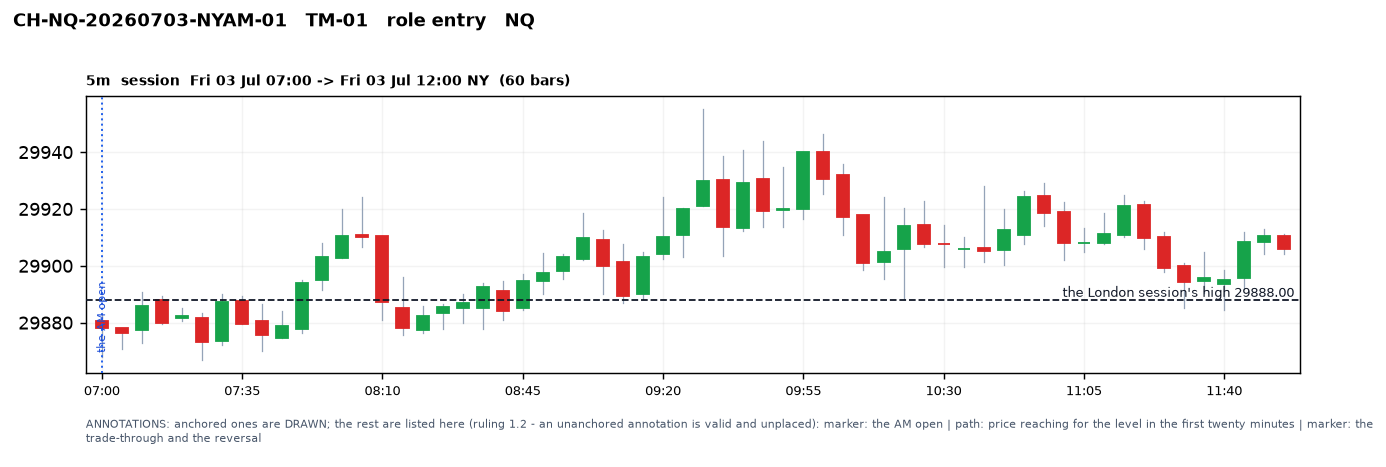
CH-NQ-20260703-NYAM-01 — the inherited level does its job. New York AM opens. The London session's high sits seven and a quarter points above. Price reaches for it in the first twenty minutes, trades through it, and reverses. What was seen: a known level from a closed session. What was done: nothing, this chapter has no entry model. What happened: the level was reached and rejected, which is the behaviour the mechanism predicts.
CORRECTION, 12 August 2026 — PROSE MINT-DEFECT, ruled by Jovan Kalyango (ballot item 2). [SUPERSEDED, RETAINED] this read: "The prior session's high sits fourteen points above." BOTH HALVES WERE WRONG AND ONE MADE THE OTHER UNCHECKABLE. "The prior session" was undefined until 12 Aug, when it was ruled the prior futures session for day-boundary purposes and then scoped to the LONDON session for proximity passages like this one — the author's intent, with TM-11 carrying the scope line. And nothing on this date sits fourteen points above the AM open: the prior futures session's high is +439.25, the overnight high +19.50, and London's is +7.25. THE CORRECTED SENTENCE PASSES ITS OWN ARITHMETIC, measured on
NQ_1m_full.csv, 12 Aug 2026: the AM open is 29880.75, London's high is 29888.00 — +7.25 — price first touches it at 07:13, inside the first twenty minutes, and reverses 21.25 points to 29866.75 by 07:29. (It trades above the level again from 07:55 and makes 29955.25 by 09:33; the chapter claims a rejection, not a permanent one.) Evidence:workorders/CORRECTIONS-BALLOT.mditem 2, and the two scan records inworkorders/RE-DATED-BY-SCAN.md— both returned ZERO, which is why the number was corrected rather than the date.
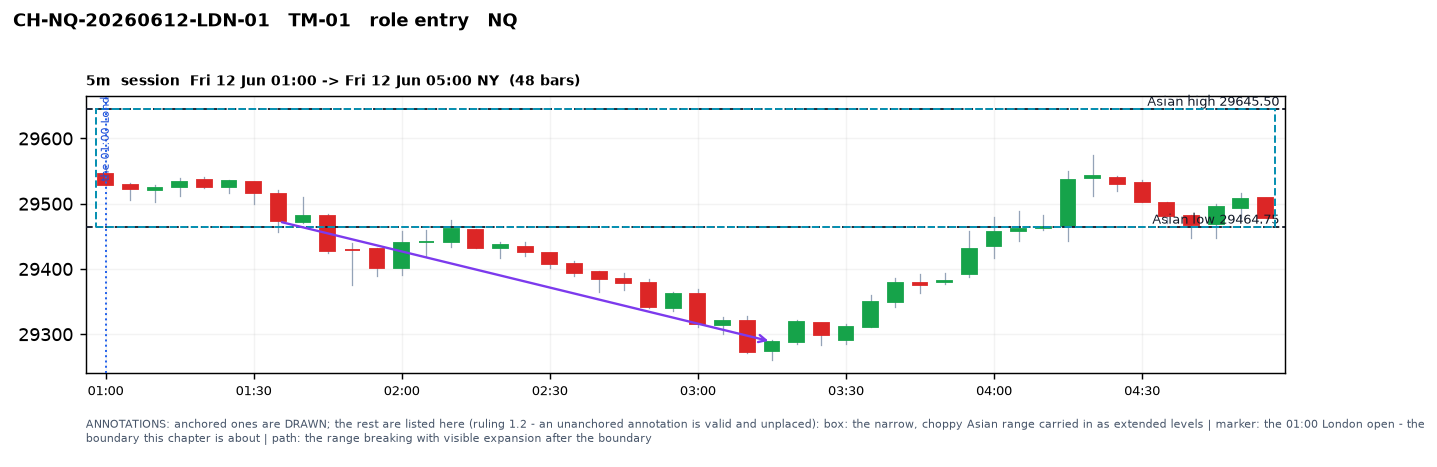
CH-NQ-20260612-LDN-01 — session character changing at the boundary. The Asian range is narrow and choppy. London opens at 01:00 and the range breaks with visible expansion. The same instrument, the same chart, a different character on either side of one clock time. What was seen: a boundary. What was done: nothing. What happened: the boundary was where the change occurred, which is the whole claim of this chapter.
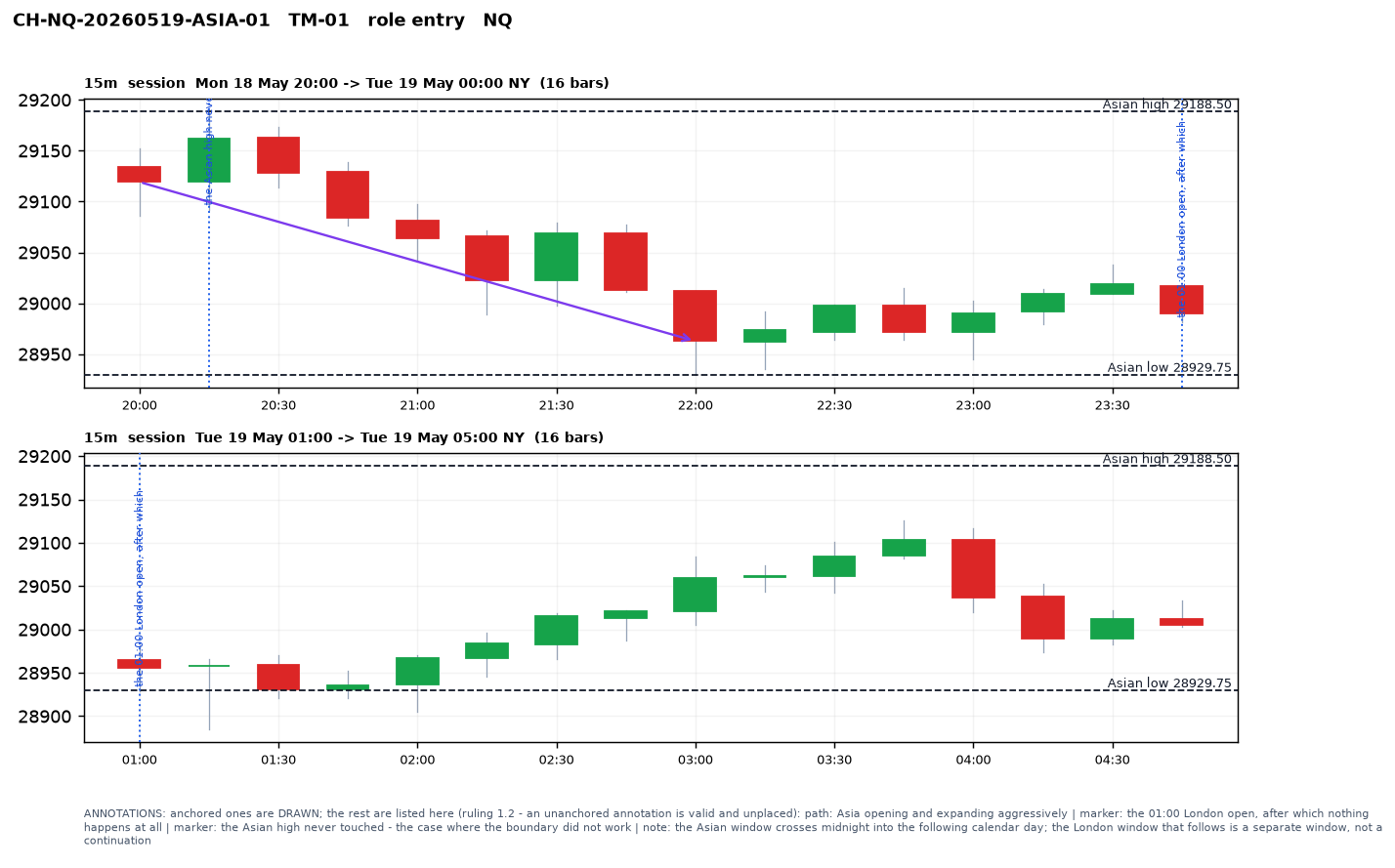
CH-NQ-20260519-ASIA-01 — the case where the session boundary did not work. The Asian session opens and expands aggressively; London opens and does nothing at all. The inherited Asian high is never touched. If you had traded a rule of "London expands from the Asian range" you would have taken a loss, or more likely sat in a position that went nowhere and closed it at a small loss out of boredom.
This is the example that matters most. Session boundaries are where change tends to happen. They are not where change must happen. A concept that is right most of the time will still be wrong today, and no amount of correct reasoning about desks and shifts changes that.
6. Exercises
- Set a chart to New York time and mark the four session windows in section 3 for the last five trading days. Screenshot each.
- For those same five days, mark the previous session's high and low at each session open. Count how many were traded through within the first hour of the new session.
- Mark the 12:00–13:30 stand-down on five days. For each, note what price did inside it, and whether you would have been tempted to act.
- Find one day where the session boundary produced no change of character at all. Explain, in two sentences, what you would have lost by assuming it would.
- Take any chart with the clock set to a timezone other than New York. Mark where you think 09:30 New York is. Then switch the clock and check. Record how far off you were.
- Identify the last exchange holiday or half-day. Pull that session up and describe how it differs from a normal one.
7. Manual backtesting
Build a tally sheet with these columns:
| Date | Session | Prior session high | Prior session low | Reached H within 1h? | Reached L within 1h? | Normal session? |
Fill it for forty consecutive trading days, for one instrument. Do not skip days that look uninteresting; the uninteresting days are the sample.
Then compute two numbers: the percentage of sessions that reached the prior session's high or low within the first hour, and the same figure excluding non-normal sessions.
You now have a measured base rate for your own instrument. Every claim made in later volumes about liquidity above and below price is a claim about this number. If your measurement disagrees with something you read later — in this book or anywhere else — your measurement is the one that came from your market.
Forty days is a small sample. Treat the result as a first estimate, not a fact.
8. Common mistakes
- Trading a chart set to the wrong timezone. Everything downstream is wrong and nothing looks wrong. Correction: set New York time once, verify it against a known event, never change it.
- Treating session boundaries as signals. A session opening is not a reason to enter. Correction: a session is context; the entry comes from a model in a later volume.
- Trading the stand-down windows. The day has two: 12:00–13:30, lunch and the dead window, and 05:00–07:00 after London closes. Neither is a quiet patch to be exploited. Correction: mark both on the chart so they are visibly off-limits rather than merely uninteresting.
- Including holidays and half-days in your sample. They inflate or deflate every statistic you compute. Correction: add the "normal session?" column to every tally sheet you ever build, and report both figures.
- Assuming session character is fixed forever. Sessions change character over years as participation shifts. Correction: re-measure annually rather than inheriting a figure you learned once.
- Treating the New York afternoon as dead time on indices. PM is a session, not a leftover. Correction: mark it explicitly; see Chapter 11.
- Confusing the session with the killzone. The New York AM session runs 07:00–12:00. The window this firm acts in on indices is 09:30–11:00. A session is hours of the clock; a killzone is a permission, and it differs by asset. Correction: see Chapter 7.
9. Cross references
Depends on: nothing. This is a root concept — it is the first thing in the system that does not require something else to be understood first.
Feeds:
- TM-02 Killzone (Ch. 7) — killzones are defined inside sessions
- TM-03 Asian session (Ch. 8)
- TM-04 London session (Ch. 9)
- TM-05 New York AM (Ch. 10)
- TM-06 New York PM (Ch. 11)
- TM-07 London close (Ch. 12)
- LQ-07 Session range liquidity (Vol. 2, Ch. 7) — the inherited extremes of section 2 become tradeable pools
10. Quantitative mapping
Formalised in DRIIPS-QS-001 §1, which fixes the time domain for the whole method: all times New York, every rule anchored to the 09:30 cash open. The match is partial and worth saying so — the specification has no section devoted to sessions, so §1 gives the convention this chapter rests on rather than the session map itself. The windows in section 3 are Driips convention on top of that anchor.
Sessions are implemented as half-open time intervals in New York time, evaluated per bar, with an explicit exchange-calendar flag for non-normal days.
One implementation note that matters to a reader who will eventually write code: session state must be recomputed from the bar timestamp rather than carried forward across bars. A session tracker that accumulates state without resetting at the boundary will report the previous session indefinitely — a failure mode this firm has encountered and fixed.
TM-01UNEXAMINEDread the honesty sentence
Formalised in DRIIPS-QS-001 §1, which fixes the time domain for the whole method: all times New York, every rule anchored to the 09:30 cash open.