The Swing Point
Chapter 1 — The Swing Point
1. Definition
A swing high is a high with lower highs on either side of it. A swing low is a low with higher lows on either side. [MS-01]
Read that carefully, because the whole concept is in the second half. A swing point is not simply a high — every bar has one. It is a local extreme qualified by its neighbours, and the qualification is what makes it nameable.
This opens Volume 3, which is about market structure: what price is doing, read from the sequence of these points. The volume works through fourteen concepts in registry order, MS-01 to MS-14, and this is the first. It assumes you have read nothing else.
2. Institutional reasoning
Where the system stops
This concept depends on nothing.
Almost everything in this system rests on something else — a session needs a clock, a pool needs a location, a raid needs a pool. A swing point rests on the chart. You can identify one without knowing anything about markets, sessions, orders or models: three bars, and a comparison.
There are four such starting points across the whole registry — one each in structure, time, risk and narrative. Liquidity, PD arrays and projections have none. Every concept in those domains reaches back through something else to arrive here or at one of the other three, which is why a reader of the liquidity volume meets swing points constantly without ever having been taught them.
Why the market cares
The reason a swing point matters is not that it is a shape. It is that several people independently agree on it.
Ask two traders to mark the last significant high on a chart and they will usually mark the same bar. Ask them to mark "a good price" and they will not. That difference is the entire mechanism: agreement is what lets orders accumulate at a location, because orders can only pile up somewhere people can find.
So a swing high is a place where protective stops of short positions and the entry orders of breakout buyers end up together — not because the shape attracts them, but because the shape is legible.
What it turns into
Four registered concepts are built directly on this one, in three different domains:
| Built on it | What it becomes |
|---|---|
| MS-04 market structure shift | Structure breaking is a swing point being taken out against the prevailing sequence |
| MS-07 change in state of delivery | The same primitive, read as a change in who is being served |
| LQ-09 liquidity raid | A raid is penetration of a level that a swing point defined |
| PD-01 fair value gap | The array forms in the space a displacement leaves between swings |
And further out, a dealing range (MS-12) is bounded by two of them — one high, one low.
None of that is taught here. The point is that a single three-bar comparison is what four other concepts are made of.
3. Recognition
The lookback is the specification
If a swing high is a high with lower highs either side, then how many bars either side? One? Five? Twenty?
That number is the concept's entire specification. It is a named parameter, and what it controls is not accuracy but resolution:
- A larger lookback yields fewer swing points, each more significant. A high with twenty lower highs on each side is a genuinely notable turn.
- A smaller lookback yields more, noisier ones. A high with two lower highs either side happens constantly.
Neither setting is right. They answer different questions, and the parameter is how you choose which question you are asking.
Three records, and they do not agree
This chapter states what the firm's records contain rather than what its setting is, because the records disagree.
| Source | What it says |
|---|---|
| The registry entry | swing_lookback = 2 on intraday timeframes |
| The quantitative specification, §3.1 | swing_lookback = 20 |
| The Pine implementation | The same parameter, named swingLen |
Two values and two names for what is written as one parameter. The ruling is pending, and there are two live readings: either one of them has drifted from the other, or they are different parameters that have been given the same name — a fine-grained working-timeframe qualifier and a coarse higher-timeframe one, which would be a reasonable design and an unreasonable thing to leave unlabelled.
Neither number is presented here as the firm's setting, because until that ruling lands nobody can say which it is. Section 10 names the study that would settle it.
The tests
- Is the bar a local extreme — higher than its neighbours for a high, lower for a low?
- How many bars either side are you requiring? Say the number out loud. It is a choice, not a property of the chart.
- Would this still qualify at double that lookback? Note the answer.
- Would another trader mark this bar? If it needs explaining, the agreement that makes it useful is absent.
- Which timeframe are you on? A swing point on a 5-minute chart is not one on a 4-hour chart, and neither is wrong.
4. Workflow
- Choose your lookback and write it down before marking anything.
- Working left to right, mark every high with that many lower highs on both sides, and every low with that many higher lows.
- Note which ones you would have marked by eye without the rule. The difference between the two sets is what the rule is doing for you.
- Re-mark the same chart at double the lookback. Keep both sets.
- Compare. The points that survive both are the ones the rest of this volume will care about most.
Abort conditions. Nothing is entered here — this volume contains no model and this chapter has no entry rule. The failure to guard against is choosing the lookback after seeing the chart, which converts a definition into a description of what already happened.
5. Worked examples
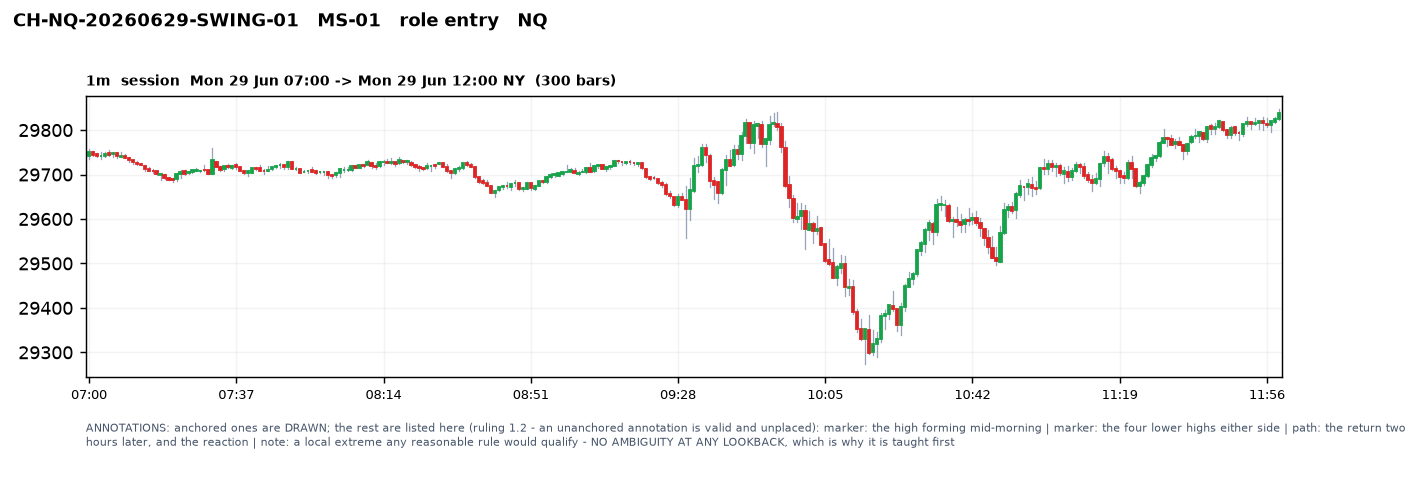
CH-NQ-20260629-SWING-01 — the unambiguous case. A high forms mid-morning with four progressively lower highs on each side and no ambiguity at any lookback. What was seen: a local extreme any reasonable rule would qualify. What was done: marked, lookback recorded; nothing traded. What happened: price returned to it two hours later and reacted — the case where the concept looks self-evident, and the reason it is taught first.
CH-NQ-20260718-SWING-02 — the same chart, two lookbacks. At a small lookback the session shows eleven swing highs. At a larger one it shows three, and two of the eleven are among them. What was seen: one price series producing two structural readings. What was done: both sets marked and kept side by side. What happened: nothing traded — the value is seeing that "the swing highs" is not a property of the chart but of the chart plus a number you chose.
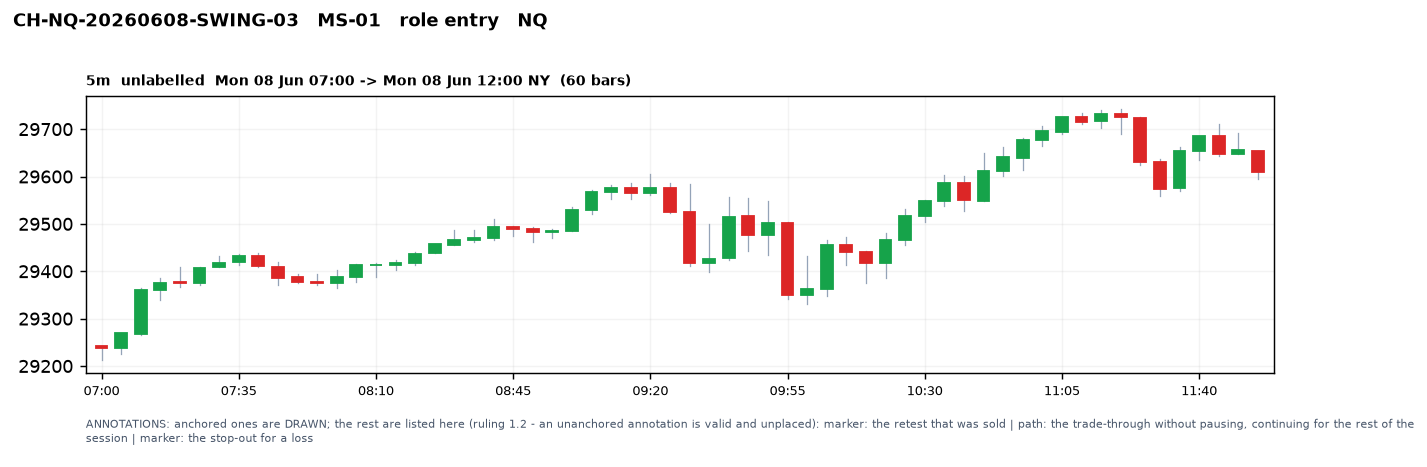
CH-NQ-20260608-SWING-03 — the noise trade, and the loss. A trader using a small lookback marks a high, treats it as a structural level, and sells the retest of it expecting a reaction. Price trades through without pausing and continues for the rest of the session. The position is stopped out for a loss.
A larger lookback would never have qualified that high. It was a local extreme in the narrowest sense — two lower highs either side, on a chart that was making them every few minutes — and it held no meaningful population of orders because too few people would have marked it. The lookback parameter exists precisely to control this, and setting it small means accepting more of these. The concept did not fail; the resolution was set to show noise and the noise was traded.
6. Exercises
- Pick a lookback, write it down, and mark every swing high and low on one session.
- Do the same session again at double the lookback. Count both sets.
- Identify which points survive both. Describe what they have in common.
- Take five points that qualified only at the small lookback. For each, record what price did when it returned there — if it returned at all.
- Ask another trader to mark the significant highs on the same chart without telling them your rule. Compare with your larger-lookback set.
- Write one sentence explaining why a swing point needs a lookback at all.
7. Manual backtesting
| Date | Lookback used | Swing highs marked | Swing lows marked | Returned to? | Reaction on return | Normal session? |
Fill it for forty consecutive sessions on one instrument — and fill it twice, at two different lookbacks.
Then compute, for each lookback: how many points were produced per session, how often price returned to one, and what happened when it did.
The comparison between the two tables is the point. If the smaller lookback produces four times as many points and the same proportion react, the extra points are free information. If they produce the same absolute number of reactions spread over four times as many levels, the small lookback is manufacturing candidates rather than finding them — and section 5's third example is what trading those costs.
Forty sessions at two settings is a first estimate. Record both sample sizes.
8. Common mistakes
- Choosing the lookback after looking. Correction: section 4, step 1. A rule set to fit the chart is a description.
- Treating "the swing highs" as a fact about the chart. They are a fact about the chart plus your parameter. Correction: section 5's second example.
- Marking a high with no lower highs beside it. That is just a high. Correction: the qualification is the concept.
- Trading small-lookback points as structural levels. Correction: section 5's third example, and the loss it cost.
- Comparing swing points across timeframes without saying so. Correction: a 5-minute swing and a 4-hour swing are different objects with one name.
- Assuming the firm's setting is knowable from this book. It is not, and the records disagree. Correction: section 3.
9. Cross references
Depends on: nothing. This is one of four root concepts in the system — the others are the trading session, the risk unit and seasonal tendencies — and the only one in the structure domain.
Feeds:
- MS-04 Market structure shift (Ch. 4) — structure breaking is a swing point taken out
- MS-07 Change in state of delivery (Ch. 7)
- LQ-09 Liquidity raid (Vol. 2, Ch. 9) — penetration of a level a swing point defined
- PD-01 Fair value gap (Vol. 4, Ch. 3)
Closely related:
- MS-02 Structural trend state (Ch. 2) — the sequence these points form
- MS-12 Dealing range (Ch. 12) — bounded by two of them
- FW-02 9:30 Open Model — the validated framework this concept runs inside
10. Quantitative mapping
Formalised in DRIIPS-QS-001 §3.1, and the match is partial — that section is titled "Dealing range & equilibrium" and defines the swing lookback as one of its parameters rather than defining the swing point as a concept. The specification treats it as a setting inside something larger.
Stage 4 means implemented, not proven. The swing detector runs inside FW-02's validated model, and no study has isolated what this component contributes on its own. Participation in something validated is not the same as being validated.
And this concept cannot be graded at all in the ordinary way. The registry records the principle directly: core primitives carry no confidence grade of their own; they inherit it from the frameworks validated on top of them. A swing point is not the kind of thing that can be right or wrong — it is a definition. What can be right or wrong is whether the definition, at a given lookback, produces objects the models use well.
The code path is core/structure/swings.py. The Pine implementation referenced is the 9:30 reversal indicator, which is not committed to this repository — an availability fact, and a different one from the pending production ruling that blocks verification against the weekly-profile build.
ICT-QS candidate — lookback sensitivity. How do swing counts, and the downstream raid and fair-value-gap detections built on them, change across lookback values on one instrument? That single study does two jobs: it measures what the parameter buys, and it settles whether 2 and 20 are one parameter drifting or two parameters sharing a name. Section 7 is its manual form.
charts: [] stands, as across this book.
[FIGURE NOT YET DRAWN - CH-NQ-20260718-SWING-02]
MS-01UNEXAMINEDread the honesty sentence
Formalised in DRIIPS-QS-001 §3.1, and the match is partial — that section is titled "Dealing range & equilibrium" and defines the swing lookback as one of its parameters rather than defining the swing point as a concept.